
I have long wished for a better understanding of the very beginning of the BBC’s own record labels. Over time, I formed a better understanding of what was being pressed up for use for BBC library use, what was being issued by the Transcription Service for other radio stations, and how they began to make their sound effects archive more widely available. The absolute start of the sales of records to the public, though, was never quite clear enough for me. A confusion of early releases 1 gradually came into focus. Their availability and something as clear-cut as a release date were lost to time.
I can now unearth what the keen record buyers would have been aware of in those early days. The press reported on the BBC’s plans to put records on sale initially, but it was in more specialist pages of The Gramophone that the birth of the BBC Radio Enterprises label was announced.
Licensing Half-Hours
BBC Radio Enterprises was announced to the world on 3rd December 1965. Press coverage focused on the part of their plans to make discs of radio broadcasts available through licensing deals with record companies. This had already been going on from at least as far back as the fifties, with credits such as ‘in collaboration with’, ‘in co-operation with’, ‘in association with’ or ‘by arrangement with’ the BBC. Tony Hancock had many records of his half-hour radio and TV shows out, as did the Goons and other comedy stars. The new department was apparently being set up to handle this exploitation more seriously.
Despite this announcement at the end of 1965, nothing relating to record licensing seems to have changed, and the Radio Enterprises department was not being used as a brand.
On 22nd September 1966, the Daily Mirror reported the creation of the BBC’s own record label, as part of BBC Radio Enterprises. This too led to nothing much happening with branding and licensed records through the rest of 1966, and almost to the end of 1967, carried no mention of Radio Enterprises.
Also, Contributions
The Daily Mirror piece led with the dire state of the corporation’s debts and the part that exploitation of its programme library could play in balancing the books. The 1967 BBC Handbook (covering 1965-66) merely comments that “In due course it is hoped that the new Radio Enterprises department, established in 1966, will also contribute”, whereas Television Enterprises is an “increasingly valuable source of supplementary income”. The 1968 Handbook, looking back at 1966-67, dryly observes that Radio Enterprises “also contributes”. A comment repeated in 1969. 1968-69 was covered in the 1970 handbook, and although there are many claims about the record sales and penetration into foreign markets, the finance department is sticking to their now standard line. Indeed, this continued until Radio Enterprises was fully absorbed into BBC Enterprises and the finance section was revamped. The glory days of BBC records sales were some way off.
Tipple Off
The Daily Record also reported the creation of the Radio Enterprises label and had the presence of mind to contact Harry Tipple, secretary of the Gramophone Retailers’ Association, for comment. Tipple had only heard the news about a BBC record label when everyone else had. Based purely on this lack of notification, he concluded that these BBC records “would not be going directly to retailers.” A good guess, it turned out.
Out On License
As no BBC label records were released at the time, this announcement was more a statement of an intention than a launch into the market. To the average record shopper, there was no indication that such a brand existed, even through much of 1967.
The first mention I can date (only somewhat accurately) is from a broadcast of Ted Heath on 23rd September 1967. The Radio Times listing states that “Decca Records are to issue an L.P. of this programme by arrangement with BBC Radio Enterprises 2.” This was the Ted Heath 21st Anniversary Album 3. Henceforth, 4 records licensed from the BBC were credited as by arrangement etc. with BBC Radio Enterprises, and not simply the BBC 5.
Our Knowledge, Presented
The Gramophone was the first to break the news of two actual BBC Radio Enterprises records, in the December 1967 issue. This was over a year since the news of the label, and the vain hope of alleviating the BBC’s financial woes.
The December issue would have been on newsstands around the start of November. It’s common practice to pre-date magazine editions to keep the appearance of being ‘of the moment’ as long as possible. It follows that they were writing it up to the end of October. News of these record releases is therefore already a couple of months older than the publication month on the front of the magazine.
Thus, at least twelve months had passed since the announcement of a BBC Radio Enterprises record label and the release of any records. As the label was staffed by a bunch of old hands from radio production and other assorted BBC staff, it might be no surprise that it took them so long 6.
Special Issues
These first BBC records feature in the Special Issues section of the Gramophone magazine. This column reviewed records “available through record dealers to special order only.” To help the readers with this special ordering, they add: “Details may also be obtained from the address, where given.” Meaning that they also endeavour to provide details of where you can order from, either directly from the record companies or through specific dealers.
Noting well that they were not going to be in the racks of your local record retailer (tip of the hat to the canny Tipple of the GRA), what have we got?
Our Present Knowledge of the Universe.
Lecture given by Sir Bernard Lovell, FRS
BBC Radio Enterprises (M)
RE1/2
(12 in., 42s. incl. PT).
BBC Radio Enterprises Department, Broadcasting House, London W1.
There’s a microcosm of information just in that heading. Let’s parse it for all the available facts.
It is expected to see Our Present… among the first BBC records to make it out into the world. Any look at a discography makes it clear that this is numbered 1 in the BBC Radio Enterprises catalogue. We already know what it is called, who did it, when it was recorded by the BBC, and that it’s a 12-inch LP presented in glorious mono (M)7.
The price holds some interest, but as it includes purchase tax (PT) and postage, we’ll come back to that later for a more careful dissection.8
The address given for the aforementioned ordering is only mildly diverting for the addition of ‘department’ to the abbreviation on the sleeves and labels of these early records. Yet it is also highly pertinent, given that the context of the review is within Special Issues.
To spell things out, you could only buy this record by writing to the address at Broadcasting House with (presumably) a cheque or postal order for the stated sum and your name and address. And only if you knew that was possible, by reading The Gramophone. I suspect that some back announcing or other hints were also being given on BBC Radio and the Radio Times. Copies of the RT from this period would be worth a look to see if there was an advert.9
Matrix Management
What really gets my attention in the heading is the catalogue number “RE 1/2 “. I have already shown 10 that the more familiar full-colour sleeve issue of Our Present… was a reissue. This really proves it beyond doubt. The reissue has a price code ‘A’ catalogue number, REA 1, and there’s ample evidence that this price code format was adopted well into 1968.
What the reviewer, Roger Wimbush, surely had in his hands in late 1967 was the original issue, in the BBC Radio Enterprises company sleeve, where the only identifying numbers were the matrix numbers, which also appear on the labels. He simply combined the two sides’ numbers to fill in for an otherwise missing catalogue number.
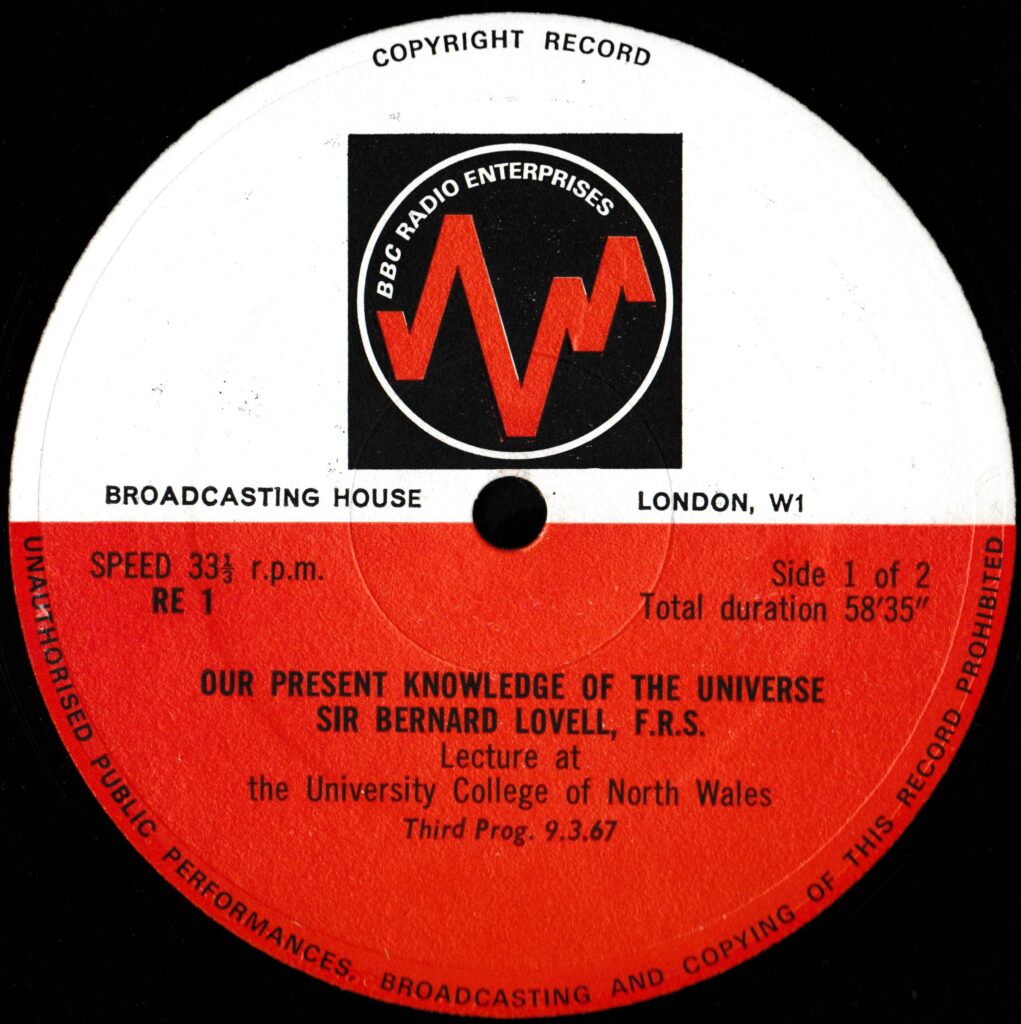
Note that this is different to the reissue, which carries the matrix code re/1 and the catalogue number REA 1M
Fellow of the Royal Mail Society
To recap, Our Present Knowledge of the Universe was a mail-order-only record in a company sleeve. It’s now certain that BBC Radio Enterprises issued their very earliest records in this way and not into shops.
Although I cannot know how many were pressed, it would have been a number small enough that the limited staff at BH could have handled the demand. The very limited appearance of this original issue on the second-hand market also points to a limited run.
A Year In the Making
It appears that Our Present… was sent by BBC Radio Enterprises to The Gramophone for review around October 1967. It could be a bit earlier than that, because a second record review in this December issue implies they came not together but one after the other. So, let’s assume early October or even late September 1967, at the latest, else it would have made the November edition.
This is three to four months after a repeat airing of Our Present… on Network Three, 6th June 1967.11 I make that point because it might be imagined that the issuing of the record was timed to coincide with that repeat, whilst it seems to have come sometime later, and all the indications are that BBC Radio Enterprises was in operation from September 1967, 12 months after the press announcement about the label.
Beyond Our Roger
Roger Wimbush begins his review with an anecdote. He recalls a conversation with the Chief Astronomer (sic)12 of the London Planetarium13 in which he wondered how one could give talks on the subject to a wide audience. He goes on to point out that whilst there are parts of Sir Bernard’s talk which are ‘beyond’ him, and therefore, probably interesting to the expert, he was nonetheless fascinated.
He continues by giving a flavour of the talk, concluding with the pious assertion that “Genesis, Chapter One, is still untouched.” In closing, he praises this “beautifully spoken”14 and “clearly recorded” LP.
The Critics’ Choice – 1967
Roger Wimbush was not done with Our Present… yet. In the annual round-up of the Gramophone’s reviewers’ picks for the year – their records of “outstanding interest and value” – the very first BBC record was garlanded with more praise, and this accolade was later highlighted when advertising the record.15
The editor’s note at the start of this section makes it clear that the reviewers are allowed to include records from the end of the previous year because, as we’ve seen, the December issue is compiled before that month.
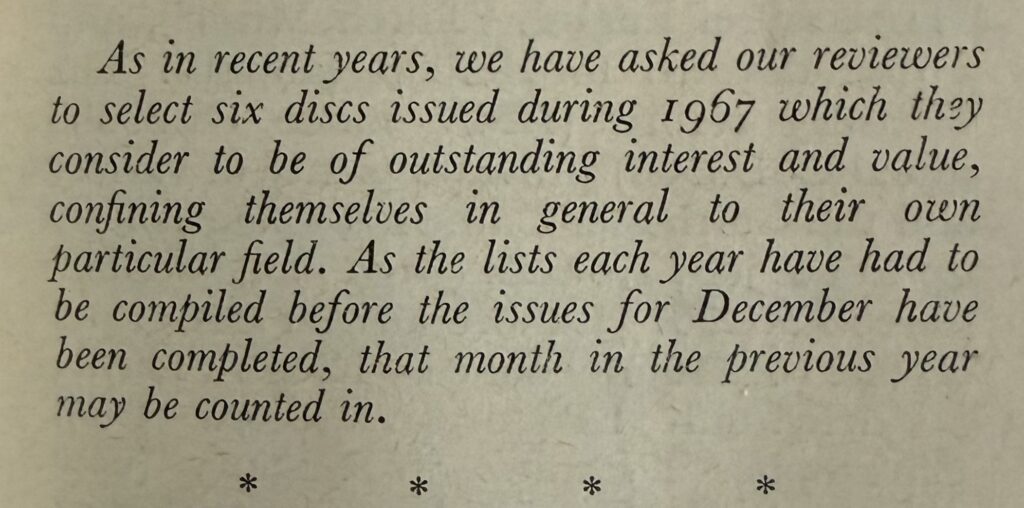
“…everybody should find hope, excitement and probably, stupefaction in listening to Sir Bernard Lovell…”
Apart from that condensed high praise, squeezed in at the end of Wimbush’s selection, this additional mention allows Roger another go at that catalogue number. This time, it is not wrong, but not really right either, because he chose the side 2 matrix/label number ‘RE 2’.
The Other Side
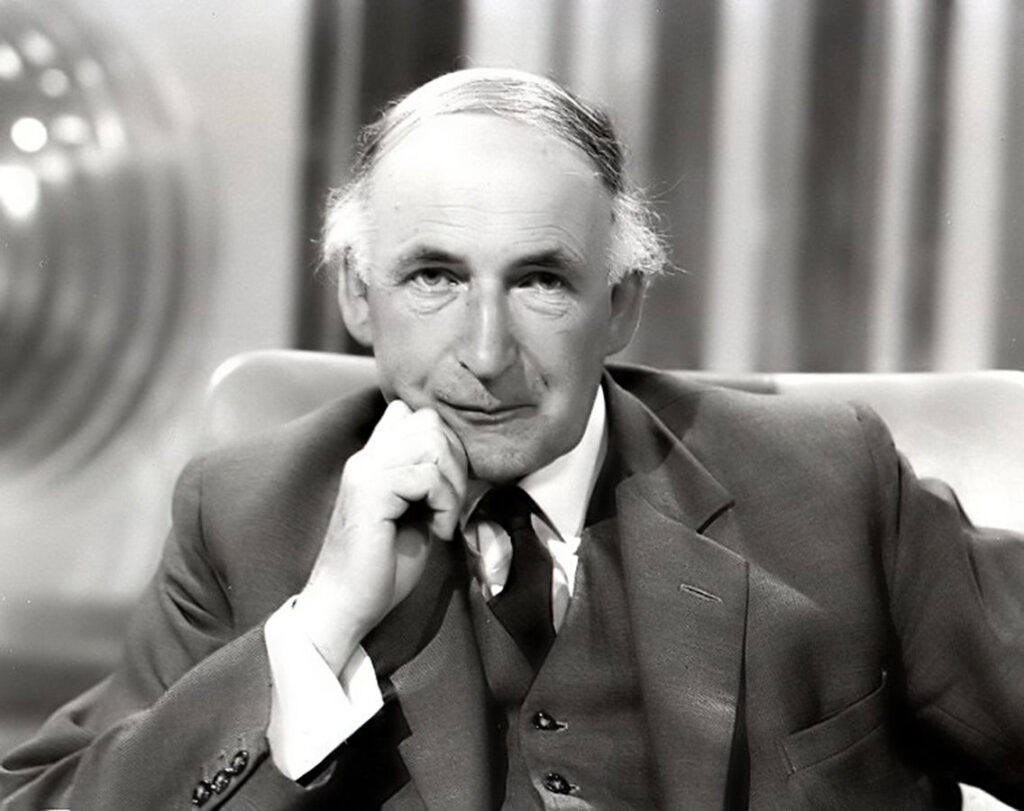
Not mentioned by the Gramophone, nor directly by the BBC, for obvious reasons, was the fact that Sir Bernard Lovell was, through the autumn of 1967, appearing weekly on ATV London. ATV had commissioned a 13-part series titled The Universe. This led to the photograph of Sir Bernard credited to ATV on the back sleeve of the Our Present… picture sleeve reissue.
As Far As I Know About As I Remember
The second record to appear in the December 1967 edition of The Gramophone is another well-known early catalogue number. The review of this disc comes just before that of Our Present Knowledge, although, as I hinted above, it’s not only a later catalogue number, but also slightly later to the party.
Special Record
Let’s start again with the heading for this record in the Special Issues section.
Baroness Asquith
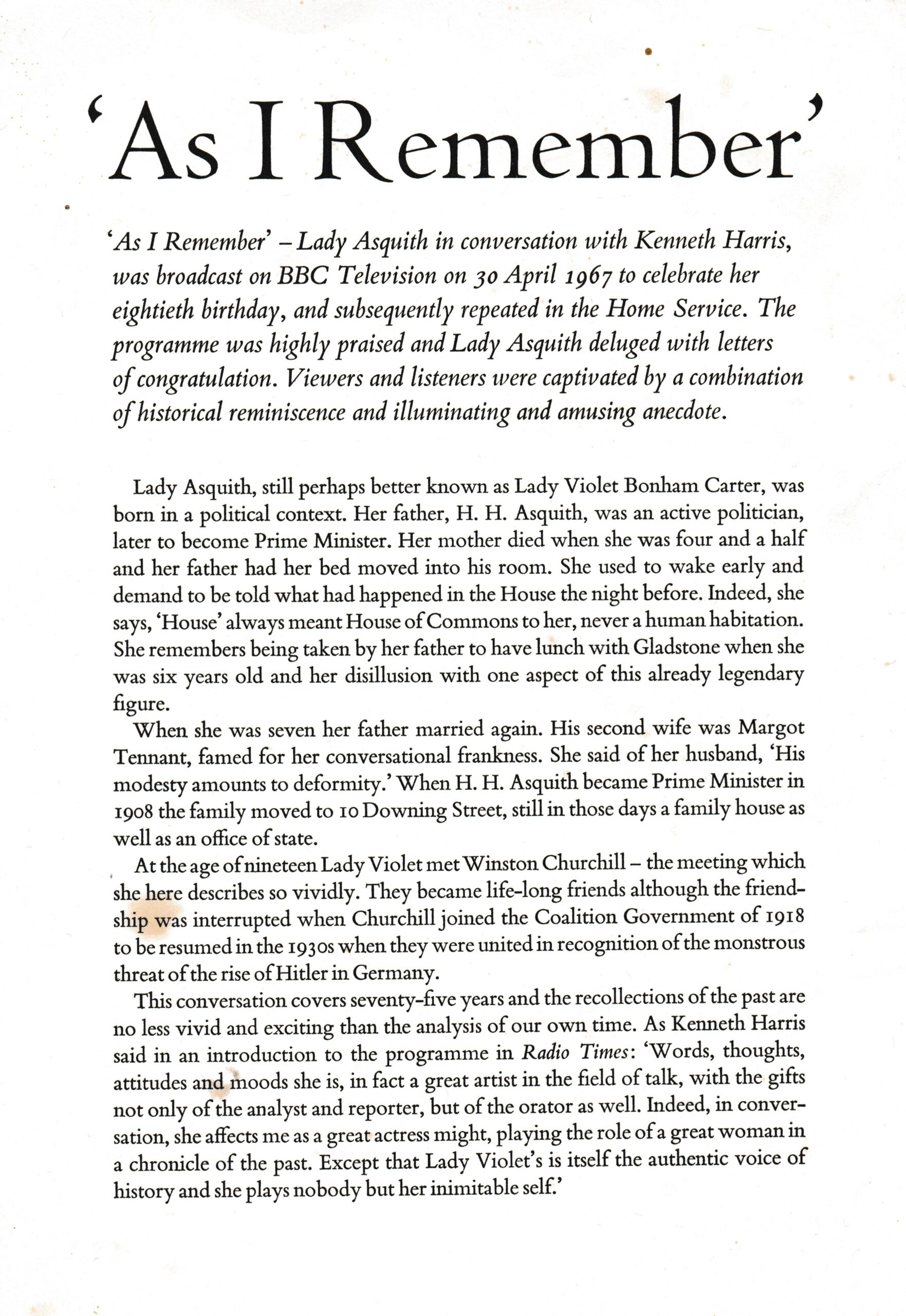
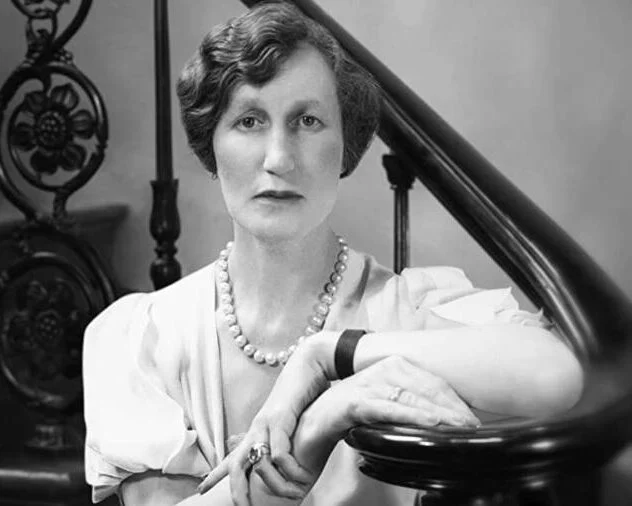
As I Remember
Lady Violet Bonham Carter (Baroness Asquith) in conversation with Kenneth Harris,
Record Specialists
(M) RE6
(32s 6d. incl PT plus 2s. 6d. postage.)
Televised by the BBC on April 30th, 1967.
Record Specialists, 4 Duke’s Road, London WC1.
There’s much to pore over in that information, so let’s contrast and compare with Our Present Knowledge…
The first noteworthy difference is that this record is available from Record Specialists of Duke’s Street in London WC116. So, it’s available through their mail order service17 and not direct from the BBC. This means that if you wanted both records, you’d be getting them from two separate places. I can only assume that the deal with Record Specialists was only struck later, and I wonder if both were available via this shop.18
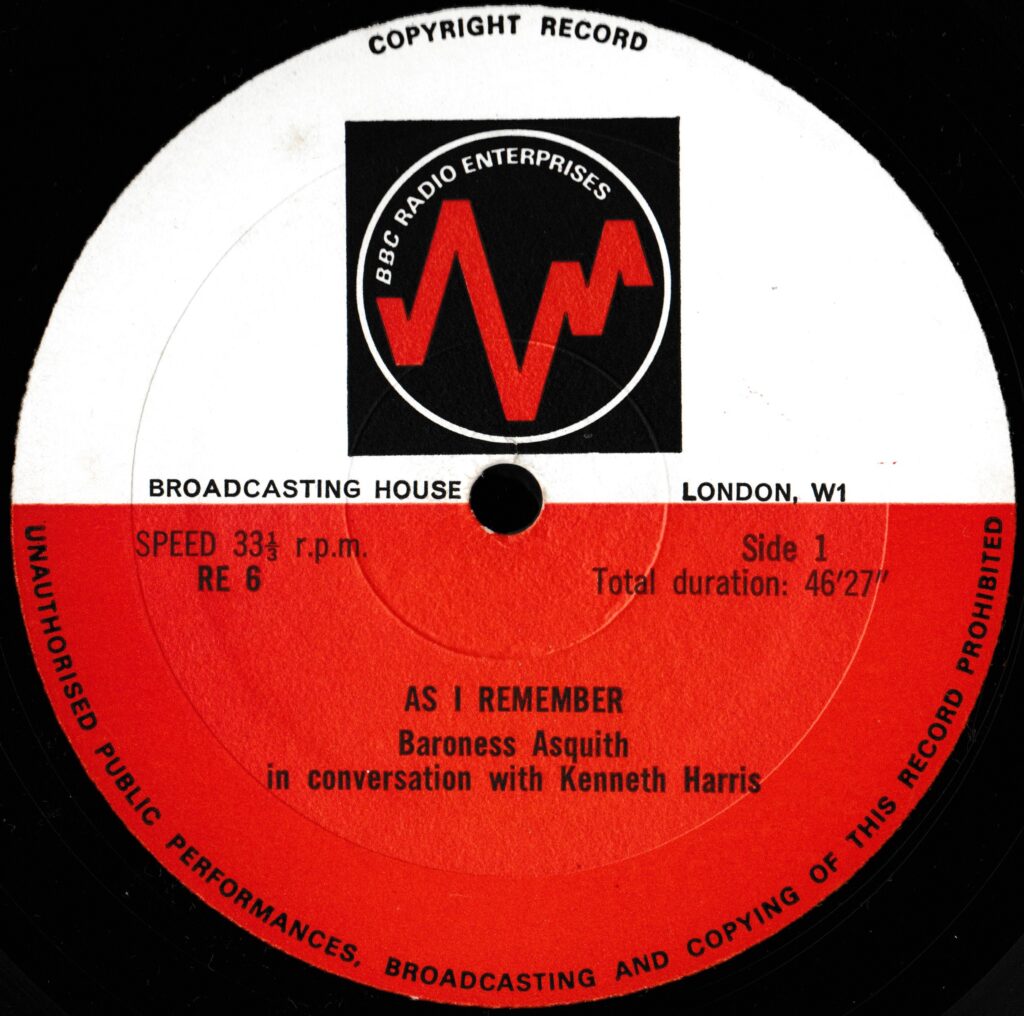
The catalogue number is given as ‘RE6,’ which, as with RE1, is taken from side one. Side 2 is RE7. So, within the three appearances of BBC Radio Enterprises records in The Gramophone, we’ve had three different interpretations of what the catalogue number should be.
Later on, As I Remember did gain the full catalogue number REB 6, so this was the best guess to make.
TV Enterprises?
Next, this is a TV broadcast. Not a radio broadcast? As I Remember was a series of television interviews, in fact. Let’s look at the whole RT listing. 19
Thu 13th Apr 1967, 21:30 on BBC One London
Lady Asquith in conversation with Kenneth Harris.
“When we arrived at Downing Street there was only one bath in the house, and that was in my father’s bedroom. And there wasn’t a single bookshelf in the house. Has no Prime Minister ever washed or read, I wondered?”
Still perhaps better remembered as Lady Violet Bonham Carter, Baroness Asquith will be eighty on Saturday.
In this programme she recalls luncheon with Mr. Gladstone when she was six… talks about her father, who became Prime Minister in 1908… about Lloyd George who succeeded him in 1916… and about Winston Churchill whom she first met as a girl of nineteen and who until his death remained one of her closest friends.
So, what do we make of Radio Enterprises muscling in on the TV Enterprises patch so early on? In fact, there’s not much in this as the whole thing was rebroadcast on the Home Service (Basic) on 27th July 1967.20 In explanation, the RT got a word from the interviewer himself.
Kenneth Harris writes:
I do not know how many people were looking at BBC-1 at 9.30 p.m. on April 13 when Baroness Asquith of Yarnbury began to answer questions from me about her recollections of her life and times; but when the programme ended fifty minutes later seven million viewers were listening to her.
What she said in that programme can be heard again this evening. If my mail bag is anything to go by, many who watched the programme on television will be listening again on radio.
The popularity of this interview is therefore plain to see, and the demand for a disc was already evident.
Best Buy
Finally, from the header, there’s the cost to consider. 32s 6d incl. PT plus 2s 6d is 35s, which is still some 7 shillings less than the equivalent – including postage – asking price of Our Present…. The price difference is as expected because the final price codes were A vs B, and in later years, 6-7 shillings was the gap between them.
Roger Wimbush begins his review of As I Remember by calling it “A wonderful record.” After continuing in enthusiastic style, he concludes: “Without the slightest doubt I name this ‘a best buy’.” I’m not saying that’s based on the price
There must have been a sense of excitement at BBC Radio Enterprises Broadcasting House on reading these reviews.
Copies of the record generally come with an A5 insert sheet, which is essentially the notes of what might have been intended for a sleeve. Although As I Remember stayed in the catalogue up to 1971 and obtained its full price-coded catalogue number, it never got a full sleeve design and, as a result, is one of the more commonly found records in the original die-cut company disco bag.
Quite why there was never an As I Remember sleeve is one of the enduring mysteries. It seems to have sold quite well, and the presence of the insert sheet indicates some kind of effort had been made so that one day a sleeve might be prepared. As I Remember remained on sale into 1971, with sales perhaps being revived by Lady Violet’s death in February 1969.
One possibility is that As I Remember remained only available by special order and was never in the shops. The catalogues I’ve seen, from 1970 onwards, leave no clue, but I do wonder if they simply sold the final copies via mail for several years.
Stop Press
In concluding comments, Rog lets us know that this record follows “soon after the lecture by Sir Bernard Lovell” and that he reviewed it in a hurry, “noticing this record just as the paper goes to press.” This clearly shows that RE6 was sent out for review sometime after he had received RE1. One wonders if he might have selected As I Remember for the critics’ choice award if only he had had it earlier.21
Dated Releases
This last-minute inclusion must have been around the end of October or early November, as I explained before. And RE1 is therefore bound to be a good week or two earlier.
As I can trace back the use of Radio Enterprises for licensing credits to late September 1967, this aligns with the window around October between the publishing cut-off dates.
For these records to be in the December edition of The Gramophone, in the way Roger Wimbush describes, they must have both been released in October 1967, shortly after the Radio Enterprises brand was first being used.
Unshrinking Violet
Roger Wimbush’s review consists of admiration for Lady Violet – “such charm and personality” – and twice re-titles her and explains his justification each time – “Margot” as she was “universally so known” is a confusion with her step-mother, so he does get a bit carried away and was perhaps showing too much haste in the speed needed to file his copy. He adds much of her biography and role in the political life of Great Britain in the preceding 60 years – the interview coincided with her 80th birthday. The quotes are well-judged and give a sense of what is so engaging about this remarkable woman of admittedly many names and titles.
1967
There you are. The fullest story I can provide of the first couple of records to go on sale from the BBC’s own label. 1967 was indeed the year, and I will put my money on October as being the release date. For whatever reason, it took a full year from the announcement of this record label to get even the licensing deals to recognise BBC Radio Enterprises as the brand, and then a handful of records to appear.
Other records were being made. RE3/4 and RE5 may have been available to purchase, although there’s no evidence of that.22 RE 8/9 was only for passengers of Cunard Line going to New York, or so it seems.23 All, very possibly, from 1967.
1968’s releases are clearer, and the Gramophone again provides the most authoritative history of what came out when. For now, I will leave you at the end of 1967 and Roger Wimbushes’s hope that:
“…the BBC will release more material of such importance and interest”
Footnotes
- See http://www.bbcrecords.co.uk/wp/an-error-of-catalogues/ ↩︎
- https://genome.ch.bbc.co.uk/649bbb506361dade05e2e9645582bc85 ↩︎
- https://www.discogs.com/master/1004811-Ted-Heath-With-Tribute-From-Count-Basie-Tony-Bennett-Marlene-Dietrich-Woody-Herman-Stan-Kenton-Johnn ↩︎
- The Gramophone reviewed Ted Heath’s 21st Anniversary in March 1967, and I can’t see any indication of its existence before 1968, even though the labels are copyright dated 1967. ↩︎
- The Brains Trust (Selections From The Famous BBC Programme), Argo DA 38, was warmly reviewed in the December 1967 edition of The Gramophone by Roger Wimbush, with a BBC Radio Enterprises credit noted. The sleeve notes are dated September 1967. Goon But Not Forgotten, Parlophone – PMC 7037 was being reviewed in the press in November 1967 ↩︎
- The reminiscences of one of the first producers, Stephen Williams, have been most illuminating about the way the BBC went about recruiting for the label https://historyproject.org.uk/interview/stephen-williams ↩︎
- http://www.bbcrecords.co.uk/record.php?record=1 ↩︎
- Suffice to say that this price is in line with the pricing of a few years later, although that was with the full colour sleeve ↩︎
- At the time of writing, the BBC’s Genome has reached the end of the 1950s in fully digitised copies of the RT ↩︎
- Again in http://www.bbcrecords.co.uk/wp/an-error-of-catalogues/ ↩︎
- https://genome.ch.bbc.co.uk/ec50604a4c44330f19d7dfda45119124 ↩︎
- It was probably the Scientific Director, Henry C King, and is it too pedantic that a planetarium is not an observatory and requires no astronomers? ↩︎
- In Marylebone, London and later a part of the Madame Tussauds. ↩︎
- He also says that Sir Bernard’s voice is a “rich Irish”, which would have come as a surprise to the Gloucestershire-born Lovell, who, as far as I can tell, was never associated with Ireland. ↩︎
- For example, the back sleeve of The Many Voices of Peter Ustinov http://www.bbcrecords.co.uk/record.php?record=26 ↩︎
- Nowadays, the offices of Language Link ↩︎
- And presumably at the shop if you lived nearby. ↩︎
- Bloomsbury certainly seems like the right sort of place to be buying a record with Baroness Asquith on. ↩︎
- https://genome.ch.bbc.co.uk/c24eaa8f421d45f586ddb6c8001e5f7b ↩︎
- https://genome.ch.bbc.co.uk/773ccaa4b40bbd830ce8cf53d8023ba5 ↩︎
- By the end of 1968, Roger Wimbush had either forgotten or was more enamoured with The Importance of Being Hoffnung (REB 21). ↩︎
- Given that they seem either extremely limited in appeal or half-cooked, I’m still trying to work out what they were for. ↩︎
- The Great Queens (RE 8/9) was made specially for Cunard, and they mostly seem to have washed ashore in the USA. ↩︎